
The $635 Billion Question: What Tech Earnings Tell Us About AI Returns To Capex
Capital allocation lessons from AWS's cloud computing journey

Issue #23
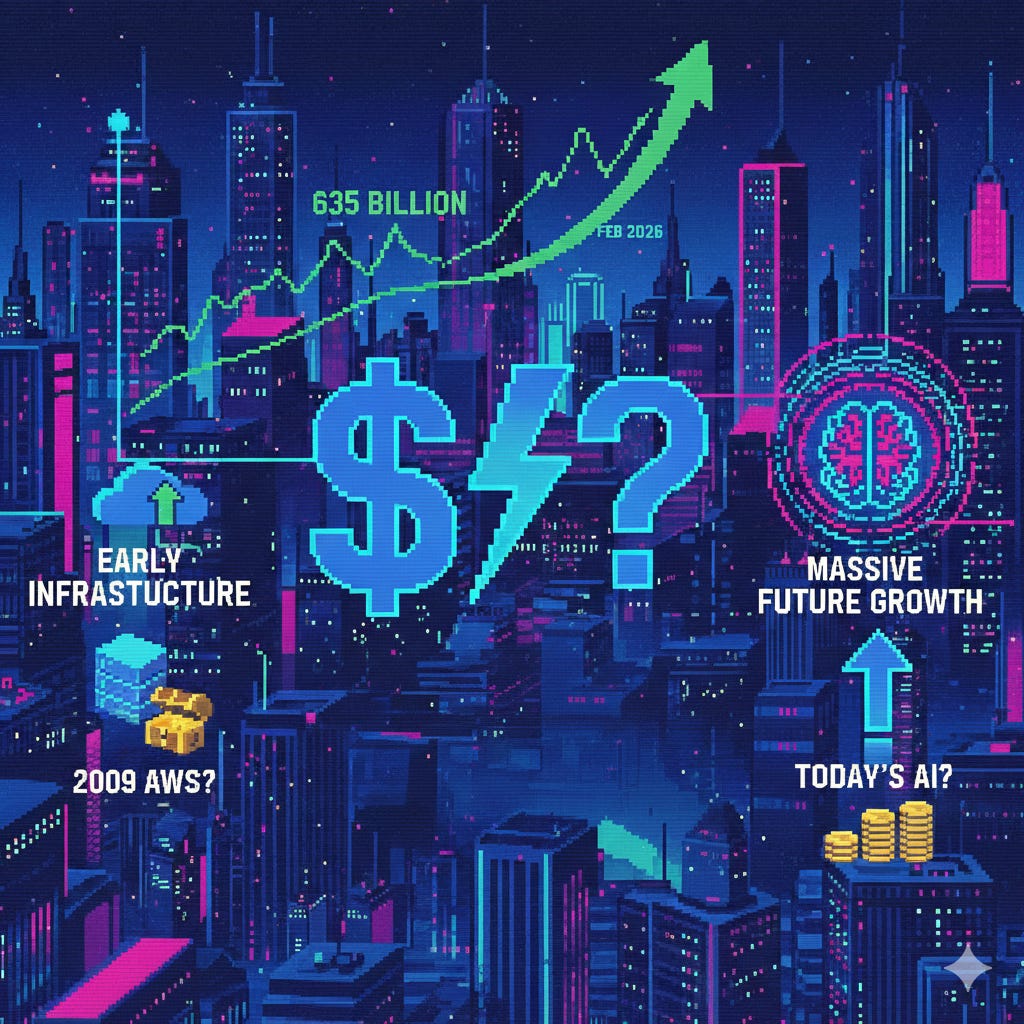
We’ve just gone through some major tech earnings and there’s one key line item that’s been causing a lot of consternation; capital expenditure guidance: Amazon at $200B for 2026, Google doubling to $175-185B. Combined with Microsoft and Meta, the four hyperscalers will spend $635-665B this year on AI infrastructure, up from $381B in 2025.
The Current Reality: Direct Economics Aren’t A “Slamdunk” Yet
The fundamental tension is straightforward:
AI infrastructure revenue yield: Direct AI services delivered ~$25B in 2025, with an additional estimated $5-10B in infrastructure revenue from foundation model companies like OpenAI (paying $38B to AWS over time) and Anthropic ($1.28B to AWS in 2025, $30B commitment to Azure). Combined ~$30-35B against ~$332B in AI-specific capex (75% of total $443B) yields roughly 9-10%. This excludes AI-augmented incremental revenue from the hyperscaler’s own business lines, such as advertising-based businesses like Meta and Google or shopping at Amazon (more on that below).
Scale creates uncertainty: Even with foundation model revenue included, the sheer magnitude of $635B in 2026 capex, nearly double 2025 levels means returns remain uncertain. A 9-10% yield on last year’s spending doesn’t guarantee similar returns on dramatically larger future investments.
Capital intensity: Microsoft at 45%, Oracle at 57% approaches utility levels, not tech economics (traditional tech: 10-15%)
Debt surge: $108B raised in 2025, with capex + dividends + buybacks now exceeding operating cash flow
ROI Reality: Enterprise use cases are still relatively limited at scale, but that’s changing quickly.
The Proof Point: AI Advertising at Scale
While infrastructure returns remain uncertain when viewed against the broader spectrum of AI usage, Meta and Google demonstrate what successful AI monetization looks like at massive scale with regards to their core businesses in advertising.
Meta: $196 Billion Advertising Engine Powered by AI
Meta generated $196.18B in advertising revenue in 2025, up 22.1% from 2024. More importantly, the company can trace specific revenue gains to AI initiatives:
Advantage+ suite: $60B annual run rate from Meta’s end-to-end AI-powered ad solutions
Video generation tools: $10B revenue run rate, with growth outpacing overall ad revenue by nearly 3x
GEM model improvements: 3.5% click lifts on Facebook from AI-driven optimization
Incremental attribution: 24% increases in incremental conversions by optimizing for actual lift vs. total conversions
AI-driven redistribution: Reallocating ads across users and sessions delivered 4x larger revenue impact than increasing ad load
The critical distinction: Meta isn’t asking investors to trust a long-term infrastructure thesis. Every quarter, it demonstrates measurable revenue acceleration directly attributable to AI features. Advertisers pay more because AI delivers better results. This is the model of successful AI monetization.
Google: Search Ads Accelerating Through AI
Google Search advertising hit $63.07B in Q4 2025, up 17% year-over-year. More telling: growth accelerated throughout 2025, from 10% in Q1 to 17% in Q4, as AI features gained traction:
AI Mode engagement: Queries 3x longer than traditional searches, with daily queries per user doubling since US launch
Spending growth: Search ad spending up 13% year-over-year while cost-per-click declined, indicating efficiency gains
AI Max for Search: Fastest-growing AI-powered Search ads product, offering comprehensive targeting and relevance improvements
Better targeting at scale: More clicks at lower average cost suggests AI is improving ad relevance and conversion efficiency
Google’s advertising success demonstrates that AI can enhance existing business models at massive scale. Search remains the profit engine; AI makes it more profitable, not by increasing ad load but by improving relevance and engagement.
Advertising shows what winning looks like: immediate returns, clear attribution, and capital efficiency. The question for infrastructure investors is whether their investments will eventually achieve similar economics; or whether advertising represents a unique use case that infrastructure spending can’t replicate.
A Historical Reminder: AWS’s Cloud Computing Journey
Watching this unfold, I’m reminded of AWS’s cloud computing buildout from 2006 to 2015. The parallels are instructive, as are the differences.
When AWS launched in 2006, Wall Street was openly skeptical. A Piper Jaffray analyst at the time called it “probably more of a distraction than anything else.” Jeff Bezos later framed a 2006 BusinessWeek article calling AWS a “risky bet” that Wall Street “disliked.”
The AWS timeline:
2006: $21M revenue, -$13M operating loss
2009: Breakeven (3 years post-launch) with modest capital
2012-2015: Already profitable (80%+ gross margins estimated by 2013) but not disclosed
2015: First public profitability disclosure (9 years post-launch)—$1.57B revenue, $265M operating income
2016: More profitable than Amazon’s retail business
Today: $107.6B revenue, $39.8B operating income (37% margin)
The critical insight: AWS scaled capital gradually in response to demonstrated demand. Spending “barely registered before 2009” then grew 40-fold over subsequent years, but always in line with revenue proof points.
Four Critical Differences for Infrastructure AI
Andy Jassy explicitly invokes AWS’s history when defending current spending, stating “This isn’t some sort of quixotic top-line grab.” The advertising success proves AI can deliver exceptional returns. But four fundamental differences distinguish today’s infrastructure AI investments from AWS’s cloud computing buildout:
Scale and pace: AWS scaled gradually over years, proving economics before expanding. AI infrastructure is front-loaded - Amazon’s $200B in 2026 alone likely exceeds AWS’s cumulative first-decade investment. The bet: if advertising proves AI works, infrastructure demand for broad-based AI applications will follow at massive scale.
Competition: AWS enjoyed first-mover advantage, capturing 70%+ market share with monopoly-like returns. Today’s AI build-out is a simultaneous arms race among 4-5 hyperscalers spending $100-200B each. Advertising shows multiple winners are possible (Meta AND Google both thriving), but infrastructure faces the question: will demand grow fast enough to support everyone’s capacity?
Revenue visibility - the split reality: AWS had clear early demand signals for infrastructure itself. Today presents two divergent paths: advertising has exceptional visibility (Meta $196B with clear attribution, Google accelerating to 17% growth), proving AI delivers massive returns. But infrastructure monetization remains uncertain; 9-10% revenue yield, with backlogs growing rapidly but enterprise AI ROI not fully proven out yet. The question isn’t whether AI works; advertising proves it does. The question is whether cloud infrastructure will capture advertising-like returns, or whether use cases requiring massive infrastructure remain niche relative to the capacity being built.
Capital structure: AWS was cash-flow funded, allowing patience for nine-year payback. AI increasingly relies on debt ($108B raised in 2025), which shortens time horizons regardless of management rhetoric. Debt-financed infrastructure can’t afford the luxury of gradual scaling; it needs faster conversion to service obligations.
Capital Allocation Lessons for CFOs
For CFOs evaluating infrastructure investments with extended payback periods, several principles emerge from comparing AWS’s cloud computing success, Meta’s advertising proof point, and current infrastructure spending dynamics:
Stage-gate capital to demand signals: AWS scaled spending to revenue inflection points, proving unit economics at modest scale before betting big.
Monitor capital intensity thresholds: Above 30% signals business model transformation. At 45-57%, you’re operating with utility economics regardless of how you describe yourself.
Seek immediate attribution like advertising: Meta and Google show what successful AI investment looks like: measurable revenue impact this quarter, not in 5-10 years. If you can’t demonstrate near-term returns, think carefully about capital intensity.
Differentiate or de-risk: AWS captured value through first-mover advantage and market leadership. When competitors deploy similar capital simultaneously, as in today’s AI infrastructure build-out, returns typically compress. Identify genuine differentiation (proprietary technology, superior unit economics) or reduce capital intensity. Matching competitor spending without differentiation rarely generates attractive returns.
Match funding to timeline: AWS’s nine-year path to disclosed profitability worked because it was funded through operating cash flow. Debt-financed infrastructure with decade-long payback assumptions creates structural tension. When borrowing to fund growth, the implicit timeline for proving returns shortens, whether acknowledged or not.
Track conversion, not commitments: Rising backlogs suggest future demand but don’t guarantee cash flow. AWS’s backlog converted quickly because cloud migration offered clear value. Conversion rate can matter more than commitment size.
Implications for Investors
These CFO lessons translate directly into investment implications. Stock correlation among AI investors has declined from 80% to 20% since June. Markets are differentiating based on the principles above.
Companies demonstrating staged capital deployment, scaling in line with revenue proof points rather than racing to match competitor announcements, deserve premium valuations. Meta exemplifies this: $196B in advertising revenue with $60B+ directly attributable to AI, while spending ~$60B on AI infrastructure. Near-immediate payback with clear attribution.
Capital intensity matters for valuation frameworks. Companies maintaining tech-level capital intensity (under 30%) while generating AI returns can sustain tech-level multiples. Those operating at 45-57% capital intensity should be valued accordingly more like utilities or industrials than software companies until the return on capital is proven completely concretely and growth sustains itself in the future.
The shift from cash-flow funding to debt financing is particularly telling. Companies invoking the AWS precedent while using fundamentally different capital structures may face different outcomes. AWS could afford patience because it was self-funded. Debt creates forcing functions for faster returns, whether management acknowledges this or not.
Finally, backlog conversion rates serve as a leading indicator. Companies showing high conversion rates (above 40%) while maintaining reasonable capital intensity warrant premium allocations.
Conclusion
Are we in 2009 AWS, where patient capital is about to be rewarded? Or is something fundamentally different happening?
The optimistic case is straightforward: AWS proved that infrastructure investments with extended paybacks can create enormous value. What Wall Street dismissed as a distraction in 2006 became a $100+ billion profit engine. Meta and Google’s advertising success proves AI can deliver exceptional returns at massive scale. Perhaps infrastructure follows the same trajectory, just compressed in time and expanded in scale.
The skeptical case emphasizes what’s different: AWS was gradual, achieved quick breakeven with modest capital, enjoyed first-mover advantages, and was cash-funded. Today’s AI infrastructure spending is front-loaded, involves simultaneous competitive deployment of unprecedented capital, shows modest returns relative to investment, and increasingly relies on debt financing.
More fundamentally, Meta and Google’s advertising success sharpens the question rather than answering it. If AI delivers such spectacular returns for use cases with immediate attribution, why isn’t infrastructure showing similar economics? Meta spends ~$60B on AI capex and generates $60B+ in AI-attributable revenue within a year. Either infrastructure is early in its curve and will accelerate dramatically, or advertising represents a unique high-value use case while infrastructure serves lower-margin applications at scale.
For CFOs, the path forward is clear: capital discipline matters more than competitive mimicry. Following the AWS playbook means graduated investment tied to proof points, maintaining sustainable capital intensity, and ensuring funding structures align with realistic return timelines. Better yet, follow the Meta playbook: demonstrate measurable returns within quarters, not years.
For investors, differentiation is becoming visible. Companies demonstrating clear paths from AI investment to revenue growth, with reasonable capital intensity, strong conversion rates, and cash-flow funding, deserve premium allocations. Those building on faith or deploying undifferentiated capital in an arms race warrant skepticism, regardless of historical parallels they invoke.